
The Texas State Capitol rises over downtown Austin as both a working seat of government and a powerful symbol of the city’s heritage and Texas identity. Its architecture, history, and role in civic life tie Austin’s story to the broader narrative of the Lone Star State’s independence, growth, and cultural pride.
Origins of a Texas Icon
When a Austin was chosen as the capital of the Republic of Texas in the late 1830s and early 1840s, early capitol buildings were modest wooden and limestone structures that reflected a young government still finding its footing. One of these early buildings even burned, underscoring the need for something more permanent and fire‑resistant. Over time, as Texas joined the United States and its population and ambitions expanded, leaders recognized that the seat of government needed to match the scale of the state’s aspirations.
Planning for the present Texas State Capitol began in the early 1880s, with officials determined to create a building that would stand out among American statehouses. Designed by architect Elijah E. Myers, the project relied on a land‑grant payment scheme that awarded private developers millions of acres in the Texas Panhandle in exchange for constructing the new capitol. Construction began in 1882 and concluded with a formal dedication in 1888, giving Austin a grand new focal point that signaled the city was no longer a frontier outpost but the heart of a growing and confident state.

Architecture That Reflects Texas Pride
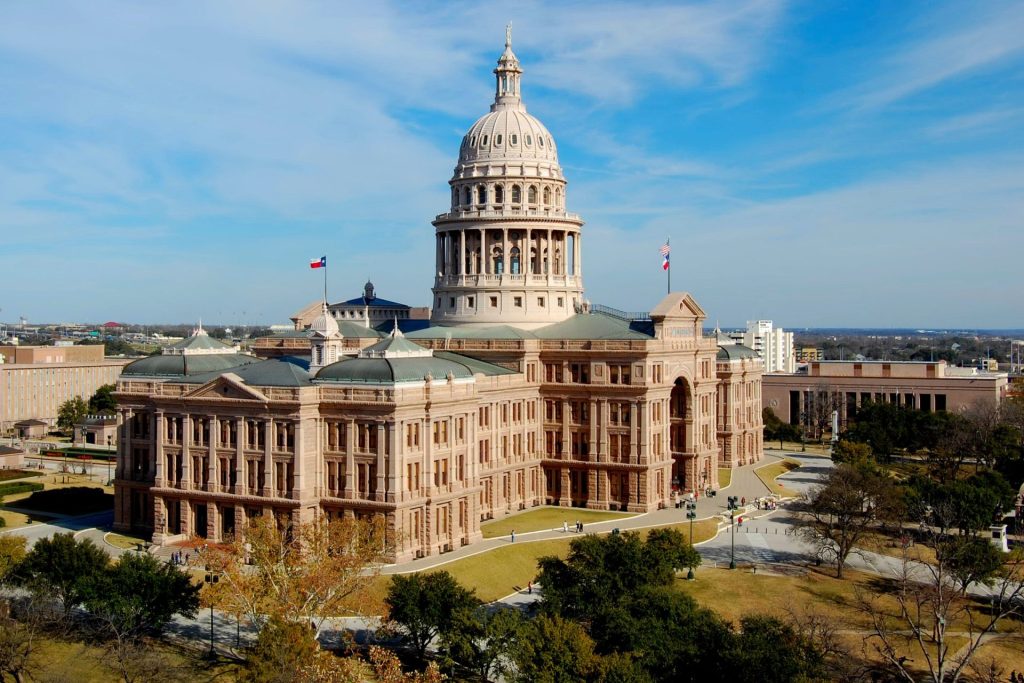
The Texas State Capitol is best known for its Italian Renaissance Revival architecture, a style that emphasizes symmetry, classical details, and imposing domes. The exterior is clad in “sunset red” granite quarried from Marble Falls in the Texas Hill Country, giving the structure its warm, rose‑colored glow that stands out against Austin’s skyline. The central dome, capped by a statue of the Goddess of Liberty, rises to about 311 feet from the ground to the tip of the statue, making it taller than the U.S. Capitol in Washington, D.C., a point of pride for many Texans.
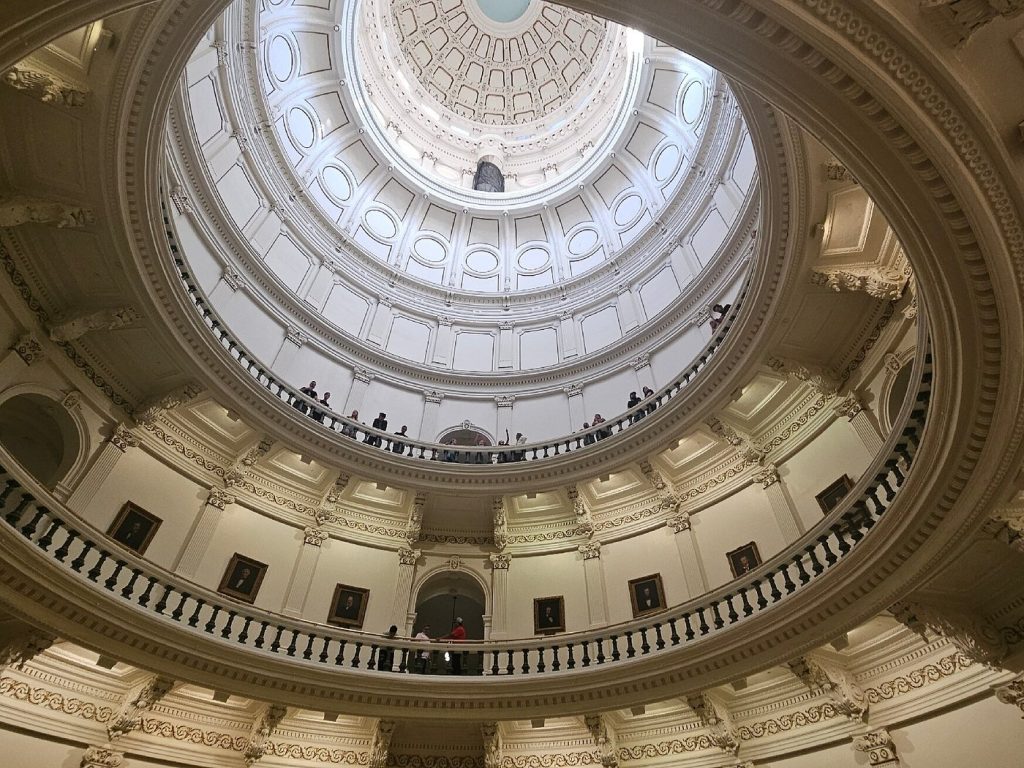
Inside, visitors encounter wide corridors, patterned tile floors, and cast‑iron staircases that reflect late 19th‑century craftsmanship. The soaring rotunda displays portraits of past Texas governors and presidents of the Republic of Texas, visually linking modern Texas to its political beginnings. The House and Senate chambers feature intricate woodwork, detailed plaster ceilings, and historic desks that have hosted generations of lawmakers, while state symbols like the lone star appear in railings, light fixtures, and floor designs. These elements make the capitol a showcase of period design and a tangible expression of Texas’s larger‑than‑life reputation.
A Living Center of Government
Beyond its beauty, the Texas State Capitol functions every day as the administrative and legislative heart of the state. It houses the chambers of the Texas Legislature and the offices of key state leaders, including the governor and lieutenant governor, and serves as the stage for legislative sessions that shape policies affecting millions of residents. During session, the building buzzes with lawmakers, staff, lobbyists, and visitors who come to testify at committee hearings, meet with representatives, or watch debates from public galleries overlooking the House and Senate floors.
The capitol grounds extend its civic role outdoors. Monuments and memorials scattered across the landscaped lawns commemorate events such as the Texas Revolution, the Confederacy, and various branches of the armed forces, turning the area into an open‑air history lesson. Walking paths, shaded by live oaks, connect the main building to nearby state offices and to the Texas Capitol Visitors Center in the restored Old General Land Office building, which offers exhibits on the capitol’s construction, Texas maps, and stories of early land policy. Together, the capitol and its grounds create a campus where government, education, and remembrance intersect in the center of Austin.
Preservation, Restoration, and Community Use
Like any historic structure, the Texas State Capitol has required careful preservation to protect its character while adapting to modern needs. A fire in 1983 damaged the east wing and spurred major safety and restoration work, including upgrades to wiring, fire suppression, and structural systems. In the early 1990s, a large underground extension was added to provide additional office and meeting space without altering the historic silhouette of the building itself, preserving the familiar skyline view of the dome rising above the trees.
Today, the capitol remains open to the public, offering free guided and self‑guided tours that lead visitors through the rotunda, legislative chambers, and key historical exhibits. School groups, tourists, and local residents use the building as a place to learn about Texas government and history, while the surrounding lawns host rallies, commemorations, and community events throughout the year. For many Austinites, documenting these spaces through photography and video has become part of how they share the capitol’s story, and local specialists such as JPM Real Estate Photography help capture the building and surrounding neighborhoods in vivid detail for property listings and community marketing. These daily interactions reinforce the idea that the capitol is not just a distant symbol of authority but a shared civic space at the heart of Austin.
A Symbol of Austin’s Heritage and Identity
For Austin, the Texas State Capitol is more than a prominent landmark; it anchors the city’s identity and urban form. Congress Avenue was laid out in the original 1839 town plan as a direct axis from the Colorado River to the hilltop where the capitol now stands, creating one of the most recognizable sightlines in the city. The building’s dome is a constant visual reference point, appearing at the end of streets, above tree lines, and in countless photographs of the Austin skyline, often framed by South Congress Avenue’s shops and restaurants.
Culturally, the capitol connects Austin’s creative, modern character with its historical roots. The city’s reputation for music, technology, and innovation exists alongside its role as seat of state government, and the capitol embodies that balance between tradition and progress. Whether illuminated at night, viewed from the grounds on a clear day, or glimpsed from popular spots in the South Congress and downtown districts, the Texas State Capitol remains a daily reminder of Austin’s heritage and the evolving story of Texas itself.